NOTE: THIS DOCUMENT IS OBSOLETE, PLEASE CHECK THE NEW VERSION: "Mathematics of the Discrete Fourier Transform (DFT), with Audio Applications --- Second Edition", by Julius O. Smith III, W3K Publishing, 2007, ISBN 978-0-9745607-4-8. - Copyright © 2017-09-28 by Julius O. Smith III - Center for Computer Research in Music and Acoustics (CCRMA), Stanford University
<< Previous page TOC INDEX Next page >>
FIR Filters
FIXME: Consider adding a section here on the one-zero filter, as in the filter tutorial. Or scan it, finally.
Figure B.1 depicts the general, causal, finite-impulse-response filter (FIR). The impulse response
is obtained at the output when the input signal is the impulse signal
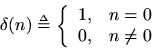
. More formally, the impulse signal is defined by
If the
th tap is denoted
, then it is obvious from Fig. B.1that the impulse response signal is given by
In other words, the impulse response simply consists of the tap coefficients, prepended and appended by zeros.
Subsections