NOTE: THIS DOCUMENT IS OBSOLETE, PLEASE CHECK THE NEW VERSION: "Mathematics of the Discrete Fourier Transform (DFT), with Audio Applications --- Second Edition", by Julius O. Smith III, W3K Publishing, 2007, ISBN 978-0-9745607-4-8. - Copyright © 2017-09-28 by Julius O. Smith III - Center for Computer Research in Music and Acoustics (CCRMA), Stanford University
<< Previous page TOC INDEX Next page >>
Projection of Circular Motion
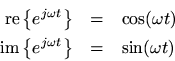
We have
Interpreting this in the complex plane tells us that sinusoidal motion is the projection of circular motion onto any straight line. Thus, the sinusoidal motionis the projection of the circular motion
onto the
(real-part) axis, while
is the projection of
(imaginary-part) axis.
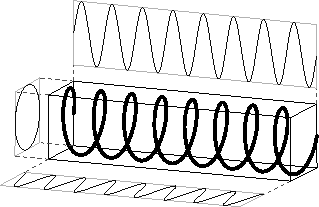
Figure 5.7 shows a plot of a complex sinusoid versus time, along with its projections onto coordinate planes. This is a 3D plot showing the
-plane versus time. The axes are the real part, imaginary part, and time. (Or we could have used magnitude and phase versus time.)
Note that the left projection (onto the