NOTE: THIS DOCUMENT IS OBSOLETE, PLEASE CHECK THE NEW VERSION: "Mathematics of the Discrete Fourier Transform (DFT), with Audio Applications --- Second Edition", by Julius O. Smith III, W3K Publishing, 2007, ISBN 978-0-9745607-4-8. - Copyright © 2017-09-28 by Julius O. Smith III - Center for Computer Research in Music and Acoustics (CCRMA), Stanford University
<< Previous page TOC INDEX Next page >>
Repeat Operator
Like the
operator, the
operator maps a length
signal to a length
signal:
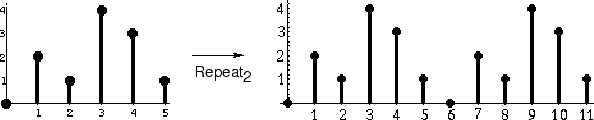
Definition: The repeattimes operator is defined by
whereis shown in Fig. 8.6. The example is
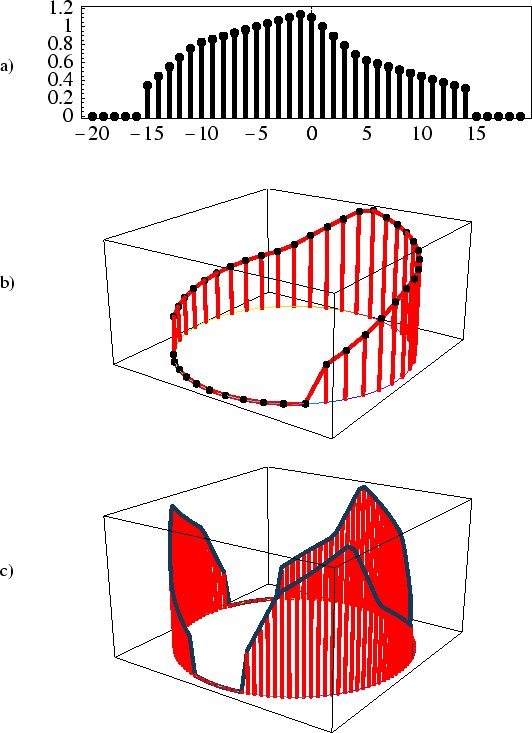
A frequency-domain example is shown in Fig. 8.7. Figure 8.7a shows the original spectrum
, Fig. 8.7b shows the same spectrum plotted over the unit circle in the
plane, and Fig. 8.7c shows
. The
point (dc) is on the right-rear face of the enclosing box. Note that when viewed as centered about
,
Figure:Illustration of . a) Conventional plot of
The repeat operator is used to state the Fourier theorem
That is, when you stretch a signal by the factor


 .
.