NOTE: THIS DOCUMENT IS OBSOLETE, PLEASE CHECK THE NEW VERSION: "Mathematics of the Discrete Fourier Transform (DFT), with Audio Applications --- Second Edition", by Julius O. Smith III, W3K Publishing, 2007, ISBN 978-0-9745607-4-8. - Copyright © 2017-09-28 by Julius O. Smith III - Center for Computer Research in Music and Acoustics (CCRMA), Stanford University
<< Previous page TOC INDEX Next page >>
Vector Addition
Given two vectors in
, say
and
, the vector sum is defined byelementwise addition. If we denote the sum by
, then we have
for
.
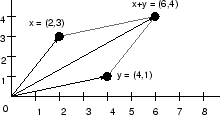
The vector diagram for the sum of two vectors can be found using the parallelogram rule, as shown in Fig. 6.2 for
,
, and
.
Also shown are the lighter construction lines which complete the parallelogram started by
and
, indicating where the endpoint of the sum
lies. Since it is a parallelogram, the two construction lines are congruent to the vectors
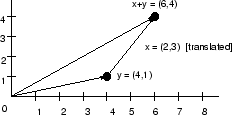
In the figure,
.