NOTE: THIS DOCUMENT IS OBSOLETE, PLEASE CHECK THE NEW VERSION: "Mathematics of the Discrete Fourier Transform (DFT), with Audio Applications --- Second Edition", by Julius O. Smith III, W3K Publishing, 2007, ISBN 978-0-9745607-4-8. - Copyright © 2017-09-28 by Julius O. Smith III - Center for Computer Research in Music and Acoustics (CCRMA), Stanford University
<< Previous page TOC INDEX Next page >>
LTI Filters and the Convolution Theorem
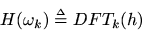
Definition: The frequency response of an LTI filter is defined as the Fourier transform of its impulse response. In particular, for finite, discrete-time signals, the sampled frequency response is defined as
The complete frequency response is defined using the DTFT, i.e.,
where we used the fact thatis zero for
and
to truncate the summation limits. Thus, the infinitely zero-padded DTFT can be obtained from the DFT by simply replacing
by
. In principle, the continuous frequency response
is being obtained using ''time-limited interpolation in the frequency domain'' based on the samples
. This interpolation is possible only when the frequency samples
finite-impulse-response (FIR) filter
, we require at least
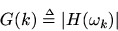
Definition: The amplitude response of a filter is defined as the magnitude of the frequency response
From the convolution theorem, we can see that the amplitude responseis the gain of the filter at frequency
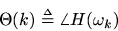
Definition: The phase response of a filter is defined as the phase of the frequency response
From the convolution theorem, we can see that the phase responseis the phase-shift added by the filter to an input sinusoidal component at frequency
The subject of this section is developed in detail in [1].