NOTE: THIS DOCUMENT IS OBSOLETE, PLEASE CHECK THE NEW VERSION: "Mathematics of the Discrete Fourier Transform (DFT), with Audio Applications --- Second Edition", by Julius O. Smith III, W3K Publishing, 2007, ISBN 978-0-9745607-4-8. - Copyright © 2017-09-28 by Julius O. Smith III - Center for Computer Research in Music and Acoustics (CCRMA), Stanford University
<< Previous page TOC INDEX Next page >>
The Quadratic Formula
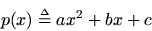
The general second-order polynomial is
where the coefficientsare any real numbers, and we assume
since otherwise it would not be second order. Some experiments plotting
for different values of the coefficients leads one to guess that the curve is always a scaled and translated parabola. The canonical parabola centered at
is given by
wheredetermines the width and
provides an arbitrary vertical offset. If we can find
in terms of
, we get
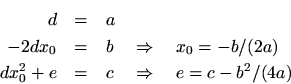
Equating coefficients of like powers ofgives
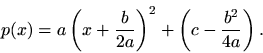
Using these answers, any second-order polynomialcan be rewritten as a scaled, translated parabola
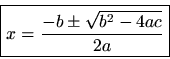
In this form, the roots are easily found by solvingto get
This is the general quadratic formula. It was obtained by simple algebraic manipulation of the original polynomial. There is only one ''catch.'' What happens whenis negative? This introduces the square root of a negative number which we could insist ''does not exist.'' Alternatively, we could invent complex numbers to accommodate it.