NOTE: THIS DOCUMENT IS OBSOLETE, PLEASE CHECK THE NEW VERSION: "Mathematics of the Discrete Fourier Transform (DFT), with Audio Applications --- Second Edition", by Julius O. Smith III, W3K Publishing, 2007, ISBN 978-0-9745607-4-8. - Copyright © 2017-09-28 by Julius O. Smith III - Center for Computer Research in Music and Acoustics (CCRMA), Stanford University
<< Previous page TOC INDEX Next page >>
The Discrete Fourier Transform (DFT)
Given a signal
, the spectrum is defined by
or, as is most often written
That is, theth sample
of the spectrum of
is defined as the inner product of
. This definition is
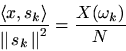
times the coefficient of projection of
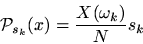
The projection of
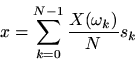
The inverse DFT is simply the sum of the projections:
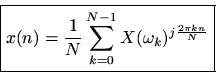
or, as we normally write,In summary, the DFT is proportional to the set of coefficients of projection onto the sinusoidal basis set, and the inverse DFT is the reconstruction of the original signal as a superposition of its sinusoidal projections.
Subsections