Informal Derivation of Taylor Series Expansion

GUIDE: Mathematics of the Discrete Fourier Transform (DFT) - Julius O. Smith III. Informal Derivation of Taylor Series Expansion

NOTE: THIS DOCUMENT IS OBSOLETE, PLEASE CHECK THE NEW VERSION: "Mathematics of the Discrete Fourier Transform (DFT), with Audio Applications --- Second Edition", by Julius O. Smith III, W3K Publishing, 2007, ISBN 978-0-9745607-4-8. - Copyright © 2017-09-28 by Julius O. Smith III - Center for Computer Research in Music and Acoustics (CCRMA), Stanford University

<< Previous page  TOC  INDEX  Next page >>


Informal Derivation of Taylor Series Expansion

We have a function $f(x)$ and we want to approximate it using an$n$th-order polynomial:

\

where $R_{n+1}(x)$, which is obviously the approximation error, is called the ''remainder term.'' We may assume $x$ and $f(x)$ are real, but the following derivation generalizes unchanged to the complex case.

Our problem is to find fixed constants $\ so as to obtain the best approximation possible. Let's proceed optimistically as though the approximation will be perfect, and assume $R_{n+1}(x)=0$ for all $x$($R_{n+1}(x)\), given the right values of $f_i$. Then at $x=0$ we must have

\

That's one constant down and $n-1$ to go! Now let's look at the first derivative of $f(x)$ with respect to $x$, again assuming that $R_{n+1}(x)\:

\

Evaluating this at $x=0$ gives

\

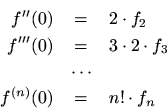
In the same way, we find

\


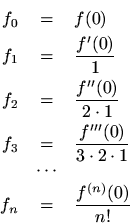
where $f^{(n)}(0)$ denotes the $n$th derivative of $f(x)$ with respect to$x$, evaluated at $x=0$. Solving the above relations for the desired constants yields

\


Thus, defining $0!\ (as it always is), we have derived the following polynomial approximation:

\

This is the $n$th-order Taylor series expansion of $f(x)$ about the point$x=0$. Its derivation was quite simple. The hard part is showing that the approximation error (remainder term $R_{n+1}(x)$) is small over a wide interval of $x$ values. Another ''math job'' is to determine the conditions under which the approximation error approaches zero for all $x$as the order $n$ goes to infinity. The main point to note here is that the form of the Taylor series expansion itself is simple to derive.

<< Previous page  TOC  INDEX  Next page >>