NOTE: THIS DOCUMENT IS OBSOLETE, PLEASE CHECK THE NEW VERSION: "Mathematics of the Discrete Fourier Transform (DFT), with Audio Applications --- Second Edition", by Julius O. Smith III, W3K Publishing, 2007, ISBN 978-0-9745607-4-8. - Copyright © 2017-09-28 by Julius O. Smith III - Center for Computer Research in Music and Acoustics (CCRMA), Stanford University
<< Previous page TOC INDEX Next page >>
Matrix Multiplication
Let
be a general
matrix and let
denote a general
matrix. Denote the matrix product by
or
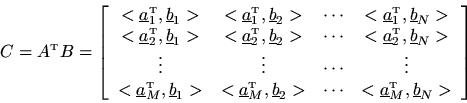
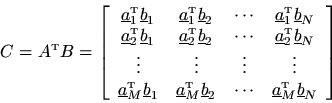
. Then matrix multiplication is carried out by computing the inner product of every row of
th row of
,
, and the
th column of
,
. Then the matrix product
This definition can be extended to complex matrices by using a definition of inner product which does not conjugate its second argument.7.4Examples:
An
can only be multiplied on the right by an
is any positive integer. An
is any positive integer. Thus, the number of columns in the matrix on the left must equal the number of rows in the matrix on the right.
Matrix multiplication is non-commutative, in general. That is, normally
even when both products are defined (such as when the matrices are square.)
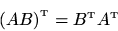
The transpose of a matrix product is the product of the transposes in reverse order:
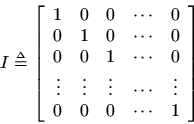
The identity matrix is denoted by
and is defined as
Identity matrices are always square. Theidentity matrix
, satisfies
for every
matrix
, for every
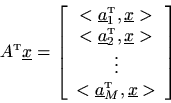
As a special case, a matrix
produces a new vector
which consists of the inner product of every row of
A matrix(constant along alldiagonals).
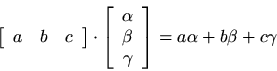
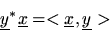
As a further special case, a row vector on the left may be multiplied by a column vector on the right to form a single inner product:
where the alternate transpose notation '''' is defined to include complex conjugation so that the above result holds also for complex vectors. Using this result, we may rewrite the general matrix multiply as