NOTE: THIS DOCUMENT IS OBSOLETE, PLEASE CHECK THE NEW VERSION: "Mathematics of the Discrete Fourier Transform (DFT), with Audio Applications --- Second Edition", by Julius O. Smith III, W3K Publishing, 2007, ISBN 978-0-9745607-4-8. - Copyright © 2017-09-28 by Julius O. Smith III - Center for Computer Research in Music and Acoustics (CCRMA), Stanford University
<< Previous page TOC INDEX Next page >>
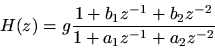
The BiQuad SectionThe term ''biquad'' is short for ''bi-quadratic'', and is a common name for a two-pole, two-zero digital filter. Thetransfer function of a biquad can be defined as
whereis called the gain of the biquad. Since both the numerator and denominator of this transfer function are quadratic polynomials in
, the transfer function is said to be ''bi-quadratic''.
The parameters
and
are called the numerator coefficients, and they determine the two zeros of the biquad. Using the quadratic formula for finding the roots of a second-order polynomial, we find that the zeros are located at
The parameters
and
are called the denominator coefficients, and they determine the two poles of the biquad. Using the quadratic formula, the poles are found to be
The biquad forms a resonator when the poles are complex, i.e., when.
If a complex pole is denoted by
, then the resonancefrequency
(in Hz) is related to pole angle
and sampling rate
by the relation
, i.e.,
.
The magnitude
of a complex pole
whereis the bandwidth in Hertz (cycles per second), and
is the sampling interval in seconds.
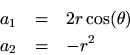
The denominator coefficients of a resonator may be expressed in terms of
Thus,A common setting for the zeros when making a resonator is to place one at
(dc) and the other at
(half the sampling rate), i.e.,
and

. This placement of the zeros normalizes the peak gain of the resonator if it is swept using the
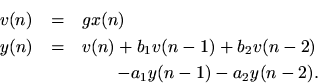
Using the shift theorem for
wheredenotes the input signal sample at time
, and
is the output signal. This is the form that is typically implemented in software.